National service hotline:008615094320000

National service hotline:008615094320000

Years of experience
solutions across various industries


National service hotline
008615094320000
一、Equipment overview
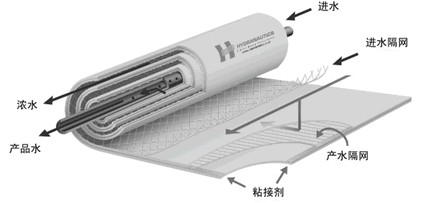
Reverse osmosis, referred to as RO, is a membrane separation technology developed in the 1960s. Its principle is that raw water passes through a reverse osmosis membrane under high pressure, and the solvent in the water diffuses from high concentration to bottom concentration to achieve separation, purification, and concentration. Because it is opposite to the direction of penetration in nature, it is called reverse osmosis. Reverse osmosis can remove bacteria, viruses, colloids, organic matter and more than 98% of soluble salts in water. This method has the characteristics of low operating cost, simple operation, high degree of automation, and stable effluent quality. Compared with other traditional water treatment methods, it has obvious advantages and is widely used in various water treatment related industries. Figure 1 shows the structure of the reverse osmosis membrane.
二、Basic principles of reverse osmosis:
Reverse osmosis is a method to reverse its natural osmosis process. Osmosis and reverse osmosis are accomplished through a semipermeable membrane. When a semipermeable membrane is used to separate two solutions of different concentrations, the solvent of the dilute solution will pass through the semipermeable membrane. The side of the membrane that enters the solution is called osmosis. When an external pressure is applied to the side of the concentrated solution, the osmosis rate will decrease. When the pressure increases to a certain value, the osmosis process stops and reaches the so-called osmotic equilibrium. The external pressure required for the equilibrium state is called osmotic pressure. When the pressure on the concentrated solution side continues to increase, that is, when the applied pressure is greater than the osmotic pressure, the solvent will reverse its original permeation direction, passing from the concentrated solution side through the semipermeable membrane into the dilute solution side. This phenomenon is called reverse osmosis. Figure 2 is the schematic diagram of reverse osmosis.
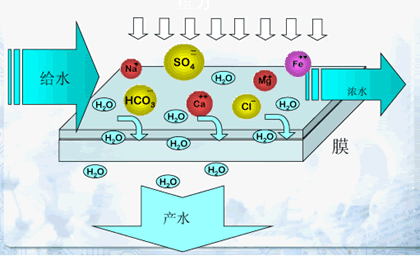
In the water purification system, pressure is applied to the concentrated solution to counteract the osmotic pressure, forcing the water from the concentrated solution to pass through the reverse osmosis membrane and collect it to obtain pure water.
三、Equipment features:
Innogreen reverse osmosis water treatment system has the following salient features:
1. Use reverse osmosis membrane imported from the United States to ensure quality and maintain the reputation of the Innogreen brand;
2. Strictly carry out personalized design based on the user's incoming water quality, equipped with a better pre-treatment system and a better membrane filtration system;
3. All system design results have been simulated through computer simulation and are highly reliable;
4. The electrical control system of the entire system is well designed to ensure that the system can achieve unmanned and fully automatic operation;
5. During the processing, each component is strictly implemented in accordance with the INNO-IS-2009 processing standard that is higher than the national standard, and the quality is far superior to that of its peers.
四、Reverse osmosis application:
Chemical industry: pure water for process, chemical circulating water, chemical product manufacturing water, etc.
Electronics industry: pure water for flushing integrated circuits, silicon wafers, display tubes and other electronic components;
Pharmaceutical industry: water for pharmaceuticals, water for large infusions, injections, tablets and biochemical products, water for equipment cleaning;
Electric power industry: boiler feed water, thermal power generation boilers, medium and low pressure boiler power systems in factories and mines, etc.;
Food industry: drinking purified water, beverages, beer, liquor, health products, etc.;
Desalination of seawater and brackish water: islands, ships, offshore drilling platforms, brackish water areas, etc.;
Direct drinking water for daily life: real estate properties, communities, schools, enterprises and institutions, etc.;
Pure water for ultrasonic cleaning: high-demand cleaning lines for computer accessories, special materials, precision machinery, etc.;
Pure water for electroplating industry: water for cleaning workpieces and water for bath liquid;
Reuse of reclaimed water and sewage: in-depth treatment of various industrial sewage to meet reuse requirements;
Heavy metal reuse: Recycle various heavy metal-containing sewage into concentrated water.
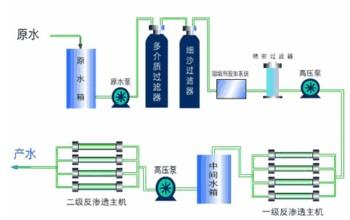
五、Conventional process flow:
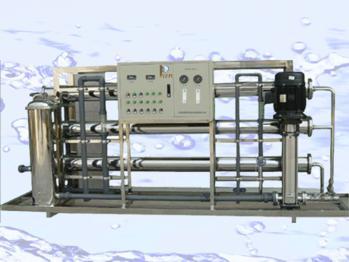
六、Equipment pictures:
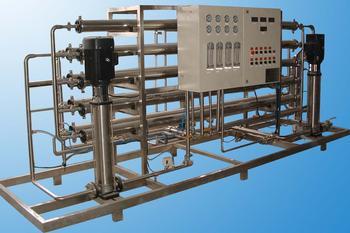
 Engineering design
 Engineering general contracting
 Water operations
 Environmental protection equipment
CopyRight © Jiangsu ZEYU Environmental Engineering Co., Ltd. Su ICP No. 14007113-1